Origins and Identity
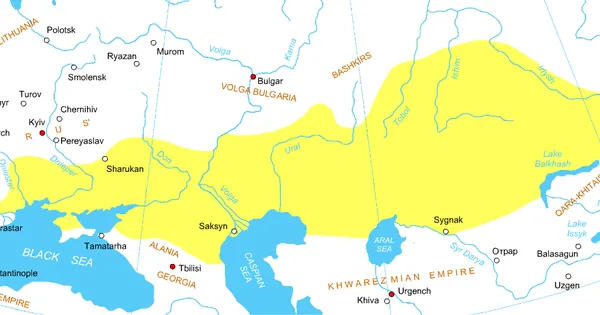
Dasht-i Kipchak: The Steppe from the Danube to the Irtysh
A geography named after a people: where did the Dasht-i Kipchak begin and end, and what was life like on this boundless steppe?
Tribe · 1050–1240
Other names: Toqsoba, Toksobichi, Toksobiçi, Toksobalar
A Kipchak tribe mentioned both in the Rus' chronicles and in Islamic sources. It is thought to have lived between the Volga and the Don or east of the Volga. Its exact homeland is unknown; the marker is approximate.
The name Toksoba is interpreted as "nine clans (oba)". In the Rus' chronicles it appears in the form Toksobichi; a similar tribal name is also found in Ibn al-Athir and in Mamluk sources.
It has been suggested that during the Mongol invasion some Toksoba groups migrated to Hungary or the Balkans. Since the lists of Kipchak tribes differ from source to source, tribal names should be identified with caution.
A geography named after a people: where did the Dasht-i Kipchak begin and end, and what was life like on this boundless steppe?
When Kumekov's eleven-tribe list of the Western Kipchaks is set beside Kıldıroğlu's findings on the Chortan tribe, it becomes clearer by which routes Kipchak tribal names reached Anatolia and where they left their traces.
Ruling the steppes of present-day Kazakhstan from the eleventh century until the Mongol invasion, the Eastern Kipchak confederation fought the Khwarazmshahs for a century and forged ties of kinship with them. Kumekov's theses and the approach of the TDV Encyclopaedia, compared.
This is the Turkish translation of an article by the Kazakh historian B. E. Kumekov, published in Russian in 1993. Drawing on the lists in Arabic sources such as al-Nuwayri, Ibn Khaldun, Ibn Duqmaq and al-Dimashqi, it offers a comparative reading of the names of the 11 tribes that made up the Kipchak tribal union of the Western Dasht-i Kipchak (west of the Itil/Volga) in the 12th and early 13th centuries…