
On the Ethnonyms of the Kipchak Tribal Unions in the Western Dasht-i Kipchak at the Beginning of the 12th–13th Centuries
Translated title; original title: XII-XIII. Asrın Başında Batı Deşt-i Kıpçak'taki Kıpçak Boy Birliklerinin Etnonimleri Hakkında
- Journal
- Sosyal Bilimler Dergisi (Kırgızistan-Türkiye Manas Üniversitesi), no. 1, pp. 380-394
- Year
- 2001
- Added by
- Emre Emir
- On this site
- · 2 min read
This text is a translation of the Turkish original. Read the Turkish original
This is the Turkish translation of an article by the Kazakh historian B. E. Kumekov, published in Russian in 1993. Drawing on the lists in Arabic sources such as al-Nuwayri, Ibn Khaldun, Ibn Duqmaq and al-Dimashqi, it offers a comparative reading of the names of the 11 tribes that made up the Kipchak tribal union of the Western Dasht-i Kipchak (west of the Itil/Volga) in the 12th and early 13th centuries, and discusses their etymologies. It argues that the Kipchaks split into Eastern and Western Kipchaks in the mid-11th century, that the tribal list is ordered by dynastic/social status, and that all the tribal names are Turkic; it rejects Ibn Khaldun's view that the Toksoba were of Tatar origin.
Translation: Mehmet Kıldıroğlu, Çıngız Samuddinov.
Main findings of the work
- At the beginning of the 11th century the Kimek ethno-political union collapsed and power passed to the Kipchak khans.1
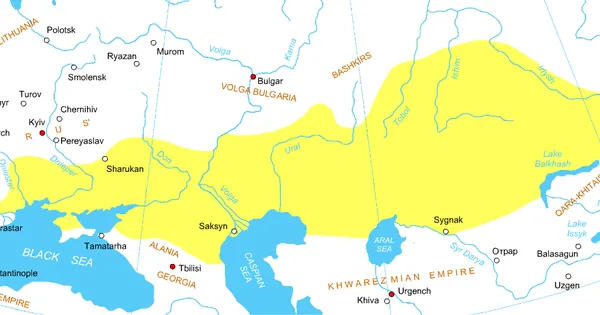
- In the mid-11th century, under the leadership of the Toksoba dynasty, the main body of the Cumans and a significant part of the Kipchak tribes migrated to the South Russian and Black Sea steppes; the Itil (Volga) became the boundary between the Eastern and Western Kipchaks.2
- The 11 tribes of the western union: Toksoba, Yetioba, Burçoğlu (Burdjogli), Elborili, Kangaroğlu, Ancoğlu (Andjoglı), Durut, Kulabaoğlu, Cortan (Djartan), Karaborklı, Kotan.3
- Toksoba is interpreted as 'nine clans' (tokuz+oba), Yetioba as 'seven clans' and Durut as 'four obas'.4
- Ibn Khaldun describes the Toksoba–Durut conflict; the Toksoba leader sought help from the Mongol Jochi.5
- Together with the Toksoba and Yetioba, the Burçoğlu tribe formed the core of South Russian Kipchak society, and some Mamluk sultans came from this tribe.6
- The Elborili (Borili) tribe held the highest rank in the Eastern Dasht-i Kipchak; Kipchak khans could come from this tribe; the name is associated with a wolf cult.7
- The Byzantines extended the name 'Cuman' to all the tribes of the Dasht-i Kipchak, a tradition that lasted until the 15th century.8
- Al-Idrisi lists unions such as Outer Cumania, White Cumania (Dnieper) and Black Cumania (Don).9
- From the 1070s onwards, considerable parts of the Cumans advanced as far as the Danube on several occasions.10
About this work
This page presents the work's citation details, the author(s)' abstract and a neutral summary prepared by our site; please consult the source in which the work was published for its full text. The points above summarise the information in the work, and the page numbers refer to the work.
Footnotes
- The author's work, p. 380. ↩
- The author's work, pp. 380–381. ↩
- The author's work, p. 390. ↩
- The author's work, pp. 381, 383–384, 387. ↩
- The author's work, p. 382. ↩
- The author's work, p. 384. ↩
- The author's work, pp. 384–385. ↩
- The author's work, p. 389. ↩
- The author's work, pp. 389–390. ↩
- The author's work, p. 390. ↩
Mentioned in this publication
Cite this publication
Kumekov, B. E. (2001). On the Ethnonyms of the Kipchak Tribal Unions in the Western Dasht-i Kipchak at the Beginning of the 12th–13th Centuries. Sosyal Bilimler Dergisi (Kırgızistan-Türkiye Manas Üniversitesi)(1), 380-394. https://kipcaktarihi.com/en/yazi/on-the-ethnonyms-of-the-kipchak-tribal-unions-in-the-western-dasht-i-kipchak-at-the-beginning-of-the-12th-13th-centuries
Kumekov, B. E.. “On the Ethnonyms of the Kipchak Tribal Unions in the Western Dasht-i Kipchak at the Beginning of the 12th–13th Centuries.” Sosyal Bilimler Dergisi (Kırgızistan-Türkiye Manas Üniversitesi) , sy. 1 (2001): 380-394. https://kipcaktarihi.com/en/yazi/on-the-ethnonyms-of-the-kipchak-tribal-unions-in-the-western-dasht-i-kipchak-at-the-beginning-of-the-12th-13th-centuries.
Kumekov, B. E.. “On the Ethnonyms of the Kipchak Tribal Unions in the Western Dasht-i Kipchak at the Beginning of the 12th–13th Centuries.” Sosyal Bilimler Dergisi (Kırgızistan-Türkiye Manas Üniversitesi), 2001, https://kipcaktarihi.com/en/yazi/on-the-ethnonyms-of-the-kipchak-tribal-unions-in-the-western-dasht-i-kipchak-at-the-beginning-of-the-12th-13th-centuries.
Contribute to this publication
Have you spotted an error, or do you have information or a source to add? Send an update suggestion based on your own knowledge and sources. No account is needed; suggestions are reviewed by the author and the editorial board.
Want to edit the text directly? Log in with your account and edit in the panel or create a free account. Your changes are reviewed side by side; if accepted, your name will appear among the contributors.


