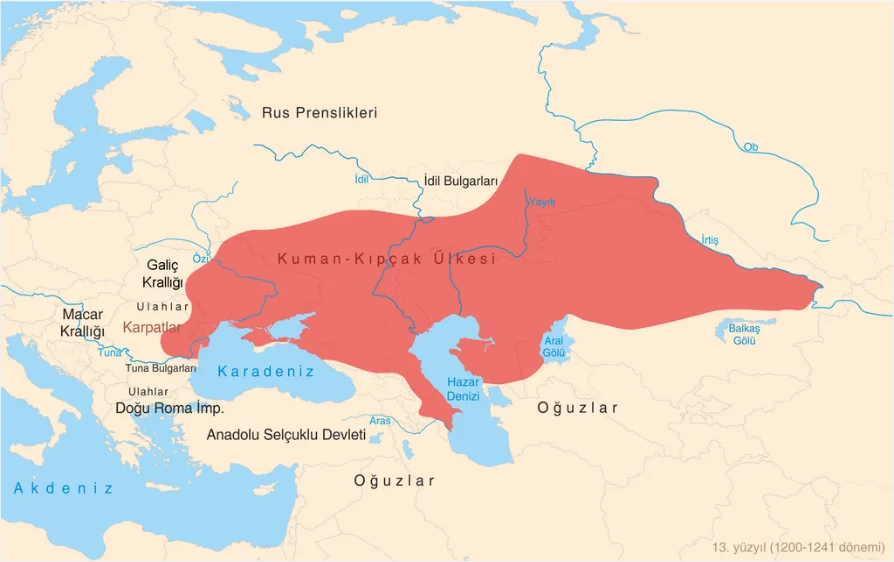
Kipchaks
Translated title; original title: Kıpçaklar
- Published in
- TDV İslâm Ansiklopedisi, vol. 25, pp. 420-421
- Year
- 2002
- Added by
- Emre Emir
- On this site
- · 2 min read · 1 read

This text is a translation of the Turkish original. Read the Turkish original
The 'Kıpçaklar' (Kipchaks) entry of the TDV Encyclopaedia of Islam (history section). It summarises the names of the Kipchaks, their origin as a branch of the Kimeks, their arrival in Southern Russia in the 11th century, their relations with Byzantium and the Rus', their settlement in Georgia, the Mongol invasion, their flight to Hungary, the Kipchakids (Kıpçakoğulları) in Iraq, the Mamluk State and their changes of religion. The file begins with the end of the preceding entry 'Kınnesrin' and ends with the first lines of the entry 'Kıpçak Türkçesi' (Kipchak Turkic).
Main findings of the work
- The common meaning of the names of the Kipchaks (Kumanos, Polovets, Falben, Khartes, Kun) is 'yellow, yellowish, pale'.1
- The Kipchaks were a branch of the Kimeks of the Irtysh, living in the Ishim–Tobol valleys.2
- When the Uz withdrew to the Balkans in 1048, the Kipchaks came to Southern Russia; they are first mentioned in the Russian chronicles in 1054 under the name 'Polovtsy'.3
- The Kipchak country was divided into five regions: Central Asia, Itil–Yaik, Don–Donets, the Lower Dnieper and the Danube.4
- They entered Hungary in 1091 and Poland in 1092, and appeared in Byzantine territory in 1093.5
- Igor's campaign of 1185 is narrated in The Tale of Igor's Campaign.6
- In 1118 the Georgian king formed a 40,000-strong cavalry army from the Cuman Kipchaks who had settled around the Çoruh and the Kura; the Kipchaks around Lake Çıldır are their descendants.7
- They were defeated by the Mongols at the Battle of the Kalka in 1223; in 1239 those of Köten's forces who managed to escape took refuge in Hungary.8
- The Mamluk State, founded in 1250, soon passed into the hands of the Cuman-Kipchak element.9
- Of the Kipchaks, who were originally shamanist, some became Orthodox Christians and some Muslims.10
- According to the 1926 census, the number of Kipchaks in Fergana was 33,502.11
About this work
This page presents the work's citation details, the author(s)' abstract and a neutral summary prepared by our site; please consult the source in which the work was published for its full text. The points above summarise the information in the work, and the page numbers refer to the work.
Footnotes
- The author's work, p. 420. ↩
- The author's work, p. 420. ↩
- The author's work, p. 420. ↩
- The author's work, p. 420. ↩
- The author's work, p. 420. ↩
- The author's work, p. 420. ↩
- The author's work, p. 420. ↩
- The author's work, pp. 420–421. ↩
- The author's work, p. 421. ↩
- The author's work, p. 421. ↩
- The author's work, p. 421. ↩
Mentioned in this publication
Explore on the live mapCite this publication
Yücel, M. U. (2002). Kipchaks. TDV İslâm Ansiklopedisi, 25, 420-421. https://kipcaktarihi.com/en/yazi/kipchaks
Yücel, Mualla Uydu. “Kipchaks.” TDV İslâm Ansiklopedisi 25 (2002): 420-421. https://kipcaktarihi.com/en/yazi/kipchaks.
Yücel, Mualla Uydu. “Kipchaks.” TDV İslâm Ansiklopedisi, 2002, https://kipcaktarihi.com/en/yazi/kipchaks.
Contribute to this publication
Have you spotted an error, or do you have information or a source to add? Send an update suggestion based on your own knowledge and sources. No account is needed; suggestions are reviewed by the author and the editorial board.
Want to edit the text directly? Log in with your account and edit in the panel or create a free account. Your changes are reviewed side by side; if accepted, your name will appear among the contributors.