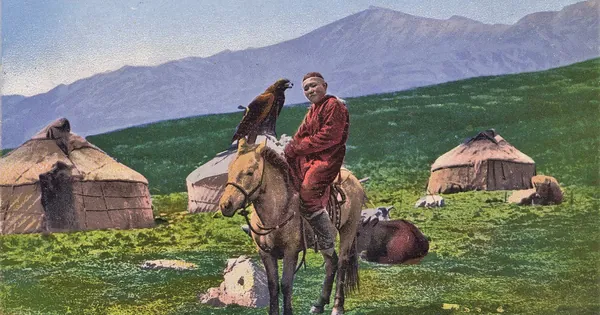
From the Kipchak Steppes to Egypt: Beyserî, Childhood Friend of the Mamluk Sultan Baybars
Translated title; original title: Kıpçak Bozkırlarından Mısır’a: Memlûk Sultanı Baybars’ın Çocukluk Arkadaşı Beyserî
An article recounting the rise of Bedreddin Beyserî, one of the Kipchak youths captured during the Mongol invasion and sold to Egypt, who as a close friend of Baybars rose from the Bahri corps to become one of the most powerful emirs of the Mamluk State.
- Journal
- Ortaçağ Araştırmaları Dergisi, vol. 7, no. 1, pp. 208-232
- Year
- 2024
- Added by
- Emre Emir
- On this site
- · 1 min read
Publisher: Ortaçağ Araştırmaları Dergisi · Licence: CC BY-NC 4.0 · Original record: dergipark.org.tr/tr/pub/oad/article/1455400

This text is a translation of the Turkish original. Read the Turkish original
Abstract
The abstract is shown in the original language of the publication.
This study examines the biography of Bedreddin Beyseri, one of the most important emirs of the Mamluks. In the 1240s, the Mongols advanced to the Caspian and north of the Black Sea and invaded and plundered the Kipchak country. Some of the Kipchak tribes fleeing from them were captured by the Mongols, and some by other nations. The children and young people of the captured Kipchak Turks were sold to slave traders and taken to Anatolia, Egypt, Syria, and Iraq. Meanwhile, al-Malik al-Salih Najmeddin (1240-1249), the Ayyubid Sultan of Egypt, bought many Kipchak slaves. He placed these slaves, called Mamluk, in the Bahri military quarry he established. Beyseri and his close friend Baybars were also brought to Egypt in this way and were recruited into the military hearth, from where they rose to become the senior part of the Ayyubid army. The Ayyubid army, including them, won a great victory against the Crusaders who attacked Dimyat in 1247. In this process, the death of the sultan and the wrong policies of his son, who succeeded him, paved the way for the establishment of the Mamluk State (1250-1517). After the Bahri commanders fell out with the Mamluk Sultan Aybek (1250-1257), Beyseri and Baybars, along with many other emirs, left Egypt and went to Syria. Baybars and Bayseri returned to Egypt during the reign of Sultan Qutuz (1259-1260) and fought against the Mongols in the battle of Ayn Djalut (3 September 1260). After Baybars (1260-1277) became sultan, his close friend Beyseri participated in the campaigns against the Crusaders, Mongols and Armenians. Beyseri was one of the most powerful emirs of the Mamluk State after Baybars, and although his name was mentioned for the sultanate, he did not accept it. Beyseri, who could not get along with Qalawun (1279-1290), who became the sultan afterwards, was arrested and imprisoned for a long time. Although he was later released, he was arrested again and died in prison.
Editorial note
In this study İlyas Gökhan examines the biography of Bedreddin Beyserî (d. 1299), one of the leading emirs of the Mamluk State. Beyserî’s story is presented as a concrete example of the slave trade that stretched from the Kipchak steppe to Egypt after the Mongol invasion, and of the rise of the Bahri Mamluks.
- It recounts that Kipchak children and young people captured as a result of the Mongols’ occupation and plundering of the Kipchak country in the 1240s were taken by slave traders to Anatolia, Egypt, Syria and Iraq.
- It states that the Ayyubid Sultan al-Malik al-Salih Najm al-Din bought many slaves of Kipchak origin and placed them in the Bahri corps he had founded.
- It relates that Beyserî and Baybars were brought to Egypt in this way and took part in the victory at Damietta in 1247 and in the Battle of Ayn Jalut on 3 September 1260.
- It shows that after Baybars became sultan, Beyserî took part in campaigns against the Crusaders, the Mongols and the Armenians.
- It states that Beyserî, who declined the offer of the sultanate after Baybars, fell out with Qalawun, was imprisoned and died in prison.
Citation and access
- Published in: Ortaçağ Araştırmaları Dergisi, 7(1), pp. 208-232 (2024)
- DOI: 10.48120/oad.1455400
- Original record: dergipark.org.tr
- Full text (PDF): on the publisher’s website
- Licence: CC BY-NC 4.0
This page presents the citation details of the work, the author’s own abstract and our editorial board’s editorial note. For the full text, please consult the original record above; when quoting, cite the original publication.
Mentioned in this publication
Cite this publication
Gökhan, İ. (2024). From the Kipchak Steppes to Egypt: Beyserî, Childhood Friend of the Mamluk Sultan Baybars. Ortaçağ Araştırmaları Dergisi, 7(1), 208-232. https://doi.org/10.48120/oad.1455400
Gökhan, İlyas. “From the Kipchak Steppes to Egypt: Beyserî, Childhood Friend of the Mamluk Sultan Baybars.” Ortaçağ Araştırmaları Dergisi 7, sy. 1 (2024): 208-232. https://doi.org/10.48120/oad.1455400.
Gökhan, İlyas. “From the Kipchak Steppes to Egypt: Beyserî, Childhood Friend of the Mamluk Sultan Baybars.” Ortaçağ Araştırmaları Dergisi, 2024, https://doi.org/10.48120/oad.1455400.
Contribute to this publication
Have you spotted an error, or do you have information or a source to add? Send an update suggestion based on your own knowledge and sources. No account is needed; suggestions are reviewed by the author and the editorial board.
Want to edit the text directly? Log in with your account and edit in the panel or create a free account. Your changes are reviewed side by side; if accepted, your name will appear among the contributors.