Stone Statues: Kipchak Sculptures and the World of Belief
On the hilltops of the steppe, stone statues holding vessels in their hands have faced east for centuries. Whom did they represent, and why were they erected?
- Added by
- Emre Emir
- On this site
- · 2 min read
This text is a translation of the Turkish original. Read the Turkish original
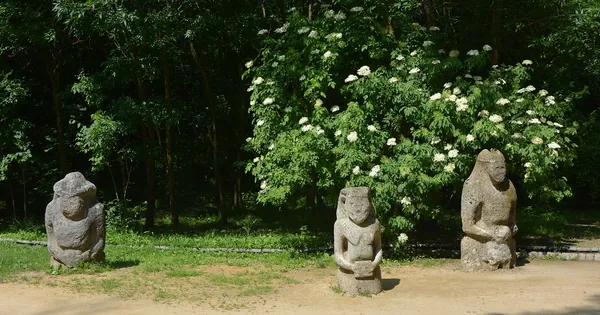
For centuries, travellers crossing the steppes from Ukraine to Kazakhstan have come across the same sight: human-shaped stone statues standing on kurgans, that is, burial mounds. A large proportion of these statues, popularly known by the Russian name kamennaya baba ("stone woman" or "stone grandmother"), were erected by the Kipchaks in the eleventh to thirteenth centuries.
What do they look like?
Kipchak statues are generally male and female figures, standing or seated, holding a vessel in both hands in front of the belly. On the men, details of helmets, armour, belts and weapons stand out; on the women, headdresses, necklaces and braided hair. These details offer researchers valuable information about Kipchak dress and equipment.
A traveller's testimony
The Franciscan friar William of Rubruck, who travelled to the Mongol capital in 1253–1255, writes that the Cumans raised great mounds over their dead and erected on them statues facing east and holding a cup at the level of the navel. This testimony is an important basis for understanding by whom and for what purpose the statues were erected.
The ancestor cult
Most researchers think that these statues represented deceased ancestors and formed part of sanctuaries built in their memory. Stone enclosures, bones of sacrificial animals and remains of offerings have been found around some of the statues. Taken together with these offering remains, the vessel held in the hands symbolises the drink and feast offered to the dead.
The excavation finds and William of Rubruck's testimony together clearly show that these statues were part of the Kipchak ancestor cult; whom each individual statue represented is examined separately for every find.
Tengri and the kams
Like other steppe peoples, the Kipchaks' world of belief rested on reverence for sky and earth and for the ancestors. Belief in the Sky God (Tengri), mountains and waters regarded as sacred, and respect for the spirits of the ancestors were parts of this world. Religious figures called kam held an important place in society; the word "kam" also appears in the Codex Cumanicus.
New religions
As the Kipchaks spread over a vast geography, they encountered different religions. Those who settled in Georgia and Hungary largely became Christian. Those who remained in the Golden Horde and the mamluks in Egypt, on the other hand, adopted Islam. This diversity shows that the Kipchak heritage does not fit into a single mould.
Where can they be seen today?
Many Kipchak statues are preserved in museums today. Foremost among them are the Luhansk and Dnipro museums in Ukraine, some regional museums in Russia and various collections in Kazakhstan. A significant number of the statues that remained in situ, however, have been damaged or moved over time.
The stone statues left no writing; but for centuries, gazing in the same direction, towards the rising sun, they have been telling of a people's existence.
Bibliography
- Rubruklu Wilhelm. Moğolların Büyük Hanı'na Seyahat (1253–1255). Çev. E. Ayan.
- Pletneva, S. A. Polovetskie kamennye izvayaniya. Moskova, 1974.
- Golden, P. B. "Religion among the Qıpčaqs of Medieval Eurasia". Central Asiatic Journal 42, 1998.
Mentioned in this publication
Cite this publication
Kıpçaklar Yayın Kurulu. (2026). Stone Statues: Kipchak Sculptures and the World of Belief. Kıpçaklar. https://kipcaktarihi.com/en/yazi/kipchak-stone-statues-kamennaya-baba-and-belief
Kıpçaklar Yayın Kurulu. “Stone Statues: Kipchak Sculptures and the World of Belief.” Kıpçaklar, 2026. https://kipcaktarihi.com/en/yazi/kipchak-stone-statues-kamennaya-baba-and-belief.
Kıpçaklar Yayın Kurulu. “Stone Statues: Kipchak Sculptures and the World of Belief.” Kıpçaklar, 2026, https://kipcaktarihi.com/en/yazi/kipchak-stone-statues-kamennaya-baba-and-belief.
Contribute to this publication
Have you spotted an error, or do you have information or a source to add? Send an update suggestion based on your own knowledge and sources. No account is needed; suggestions are reviewed by the author and the editorial board.
Want to edit the text directly? Log in with your account and edit in the panel or create a free account. Your changes are reviewed side by side; if accepted, your name will appear among the contributors.