Old Kipchak: The Cuman Language and the Codex Cumanicus
- Book
- The Kipchak Turks — Emre Emir, 2019
- Year
- 2019
- On this site
- · 6 min read · 4 reads
This text is a translation of the Turkish original. Read the Turkish original
Old Kipchak is one of the most important dialects of the Turkic family belonging to the Middle Turkic period. It is divided into three main branches: Cuman (Steppe Kipchak), Mamluk Kipchak (Kipchak in Arabic script) and Armeno-Kipchak (Kipchak in Armenian script). It was used between the thirteenth and seventeenth centuries and then passed into the period of Contemporary Kipchak. Very valuable works were written in the Old Kipchak period. When the areas over which the Turkic language spread are examined, it can be seen that Kipchak Turkic covers a very wide area within this distribution, both in the historical period and today.
Cuman (Steppe Kipchak)
Cuman (Steppe Kipchak) is a historical Turkic written language spoken by the Cumans (the Kipchaks in the West) and belonging to Old Kipchak.
Cuman, which is no longer spoken, is notably close to present-day Crimean Tatar and Karachay-Balkar.1
After the Mongol expansion in the thirteenth century, the Turkic language gained the opportunity to spread over a wide area. The great majority of the Golden Horde state, which was located in the Dasht-i Kipchak in the thirteenth century and was one of the greatest Turkic states of its time, consisted of Kipchak Turks. Only in the upper strata were there Mongols. But they too became Turkicised within a short time.2
Indeed, although the Golden Horde state existed in the Dasht-i Kipchak between 1227 and 1502, the term Dasht-i Kipchak was used for a long time.3
Codex Cumanicus
The Codex Cumanicus was written in the late thirteenth and early fourteenth centuries.4 It is the only work that has come down to us from the Kipchak (Cuman) Turks who lived in the geography of the Dasht-i Kipchak, which began in the west of Central Asia and stretched to the Middle Idil region in the north, Crimea in the south and the banks of the Danube in the west.5 The Codex Cumanicus is not the work of a single author; it was written by Italian merchants and by German priests belonging to the Franciscan order.6
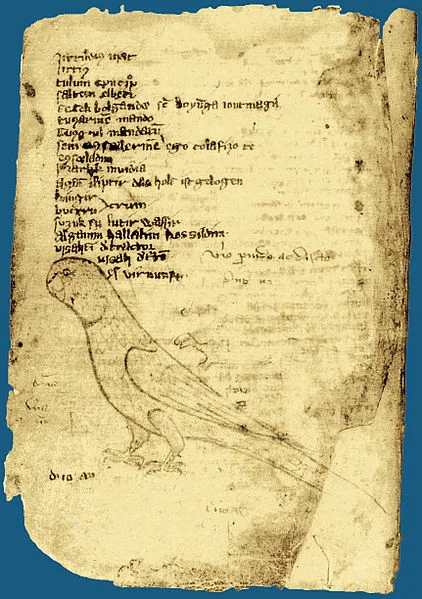
On this basis we can say that there are two different languages in the Codex Cumanicus. It was written in the Gothic letters of the Latin alphabet and consists of two separate parts. It was formed by binding together in a single volume two notebooks, one of fifty-five leaves and the other of twenty-seven. In the first notebook, consisting of a Latin, Persian and Cuman Turkic dictionary, after a Latin introduction some grammatical rules and words on various subjects are arranged according to the Latin alphabet. However, because it is closer to Italian than to Latin, this part is called the Italian Codex.
The second notebook, beginning with a Cuman Turkic–German dictionary, contains Christian prayers and hymns in Cuman Turkic and forty-seven riddles.7 The Italian copy of the Codex Cumanicus was written by a single person. The German copy, by contrast, is the work of many scribes; almost every page bears writings and interventions by different hands.8 One of the most important reasons for the writing of the Codex Cumanicus was to facilitate religious expansion. Indeed, the work contains a number of grammatical rules, translations from the Gospels, translations of a number of Catholic hymns, and Turkic proverbs.9
In 1362 the Codex Cumanicus was presented to the Republic of Venice by a book collector named Petrarch and took its place in the collection of the Library of the Cathedral of Venice. The only copy of the work is kept today in the library of St Mark's.10
In the Codex Cumanicus the word Kipchak appears as the name of a country. In addition, the language of the Codex Cumanicus is referred to as Tatar. This linguistic material bears many similarities to the dialects established on the lands of the Dasht-i Kipchak, and especially to Crimean Tatar.11 For example:
| Codex | Tatar | Old Turkic | Modern Turkish |
|---|---|---|---|
| Açuv | Açuu | Açıg | Acı (bitter) |
| Sili | Sılu | Silig | Temiz (clean) |
| Yı- | Yıy- | Yıg- | Toplama (gathering) |
| Kaygı/Kagı | Kaygı | Kadgu | Kaygı (worry) |
| Key- /Kiy- | Kiy- | Ked- | Giymek (to wear) |
Table 1.1: Fuat Bozkurt, Türklerin Dili, T.C Kültür Bakanlığı Yayınları, Kültür Eserleri Dizisi 252, p.279.
In the Codex Cumanicus, besides the eight vowels of Turkic, closed é and long vowels also occur. Some words with long vowels are spelled as follows.
Toodak/ todak = OT todak “lip”
Ééşit-/ işiit- “to hear” | kééçe / kice “night”
Béérbir- “to give” | küyna- “to reproach”
Major vowel harmony prevails. Labial assimilation has not occurred:
Acuv “bitter” | yazuk “sin”
Initial b- is preserved:
Bar = OT bar “there is” | barça = OT barça “all” | bol- = OT bol “to be, to become” | börü = OT böri “wolf”
In some examples initial b- is seen to be replaced by m-:
Meyiz = OT beniz “complexion” | min- = OT bin “to mount” | men = OT ben “I” | munça = OT bunca “this much”
The consonant system is the same as in Old Turkic. The consonants h, c and f are used only in foreign words.
The -d-, -d consonant of Old Turkic is rendered here by the sound -y-, -y:
Uyhu = OT udku “sleep” | eygi = OT edgü “good” | ayak = OT adak “foot” | key- = OT ked- “to wear”
Word-final -g/ -g sometimes turns into the consonant -v or -y:
Tav = OT. Tag “mountain” | bav = OT bag “tie, bond” | tey = OT. Teg- “to touch” | acuv = OT açıg “bitter”
Initial k- is preserved:
Keç- = OT keç “to pass” | keçir- = OT keçir- “to cause to pass” | keyit = OT ked- “garment” | kelin = OT kelin “bride” | kertek = OT kertek “bridal chamber”
Initial t- of Old Turkic is preserved:
Tağ / tav = OT tag “mountain” | talaş- = OT tala- “to squabble” | tamak = OT tamak “palate” | tamu = Skt. Tamu “hell” | tar = OT “narrow” | teg- = OT teg- “to touch” | temir = OT temir “iron”
Medially and finally, the -g-, -g sound of Old Turkic is in some examples seen to be replaced by the sound -x-, -x:
Taxdı = OT. Tagdı “was born, rose” | bax = OT bak- “to look” | agrıx = OT. Agrıg “pain” | axluk = OT ak “whiteness” | çax = OT cag “time, age”
In foreign words the appearance of initial h- is observed:
Haziz = Ar. aziz “holy” | hakıl = Ar. akl “reason” | hersek = OT. Ersek “man-crazy (woman)”
Conversely, in some foreign words the loss of h- can be observed:
Anus “yet, still” | amaşa “always”12
Some parts of the Codex Cumanicus were published by M. J. Klaproth in 1828, and the whole by Géza Kuun in 1880 with a Latin translation and commentary. Later Kaare Grønbech produced an easily usable edition of the work, consisting of one volume of facsimile (1936) and one volume of dictionary (1942). In addition, there are various studies on the work by Turkologists such as Wilhelm Radloff, Willy Bang Kaup, Gyula Németh, Annemarie von Gabain and Andreas Tietze.13
Footnotes
- Wikipedia, Kumanca, Wikipedia, “Kıpçak Grubu” https://tr.wikipedia.org/wiki/Kumanca (Accessed 11 Haziran 2019) ↩
- Fuat Bozkurt, Türklerin Dili, T.C Kültür Bakanlığı Yayınları, Kültür Eserleri Dizisi 252, p.276. ↩
- Prof.Dr. Ahmet Taşağıl, “Kuman Kıpçaklar” genelturktarihi.net/kumankipcaklar (erişilemiyor) (Accessed: 11 Haziran 2019) ↩
- Fuat Bozkurt, Türklerin Dili, T.C Kültür Bakanlığı Yayınları, Kültür Eserleri Dizisi 252, p.277. ↩
- Yrd. Doç. Dr. Jale Demirci, “Codex Cumanicus” https://web.archive.org/web/20190922164937/https://www.altayli.net/codex-cumanicus.html (Accessed: 12 Haziran 2019) ↩
- Diba Bahadıroğlu, “Codex Cumanicus” makaleler.com/codexcumanicus (erişilemiyor) (Accessed: 12 Haziran 2019) ↩
- Necmettin Hacıeminoğlu, TDV, İslam Ansiklopedisi, “Kıpçak Türkçesi”, Ankara, 2002, c.25, p.422. ↩
- Mustafa Argunşah – Galip Güner (2015); Codex Cumanicus, Kesit Yayınları (İstanbul), p.585 ↩
- Fuat Bozkurt, Türklerin Dili, T.C Kültür Bakanlığı Yayınları, Kültür Eserleri Dizisi 252, p.278. ↩
- Çağatay, Saadet. “Codex Cumanicus sözlüğü”. Türk Lehçeleri Üzerine Denemeler.- 1978, p. 141 ↩
- Fuat Bozkurt, Türklerin Dili, T.C Kültür Bakanlığı Yayınları, Kültür Eserleri Dizisi 252, p.279. ↩
- Fuat Bozkurt, Türklerin Dili, T.C Kültür Bakanlığı Yayınları, Kültür Eserleri Dizisi 252, pp.280-281. ↩
- Necmettin Hacıeminoğlu, TDV, İslam Ansiklopedisi, “Kıpçak Türkçesi”, Ankara, 2002, c.25, p.422. ↩
Mentioned in this publication
Cite this publication
Emir, E. (2019). Old Kipchak: The Cuman Language and the Codex Cumanicus. The Kipchak Turks. Kıpçaklar. https://kipcaktarihi.com/en/yazi/old-kipchak-the-cuman-language-and-the-codex-cumanicus
Emir, Emre. “Old Kipchak: The Cuman Language and the Codex Cumanicus.” The Kipchak Turks içinde. Kıpçaklar, 2019. https://kipcaktarihi.com/en/yazi/old-kipchak-the-cuman-language-and-the-codex-cumanicus.
Emir, Emre. “Old Kipchak: The Cuman Language and the Codex Cumanicus.” Kıpçaklar, 2019, https://kipcaktarihi.com/en/yazi/old-kipchak-the-cuman-language-and-the-codex-cumanicus.
Contribute to this publication
Have you spotted an error, or do you have information or a source to add? Send an update suggestion based on your own knowledge and sources. No account is needed; suggestions are reviewed by the author and the editorial board.
Want to edit the text directly? Log in with your account and edit in the panel or create a free account. Your changes are reviewed side by side; if accepted, your name will appear among the contributors.